


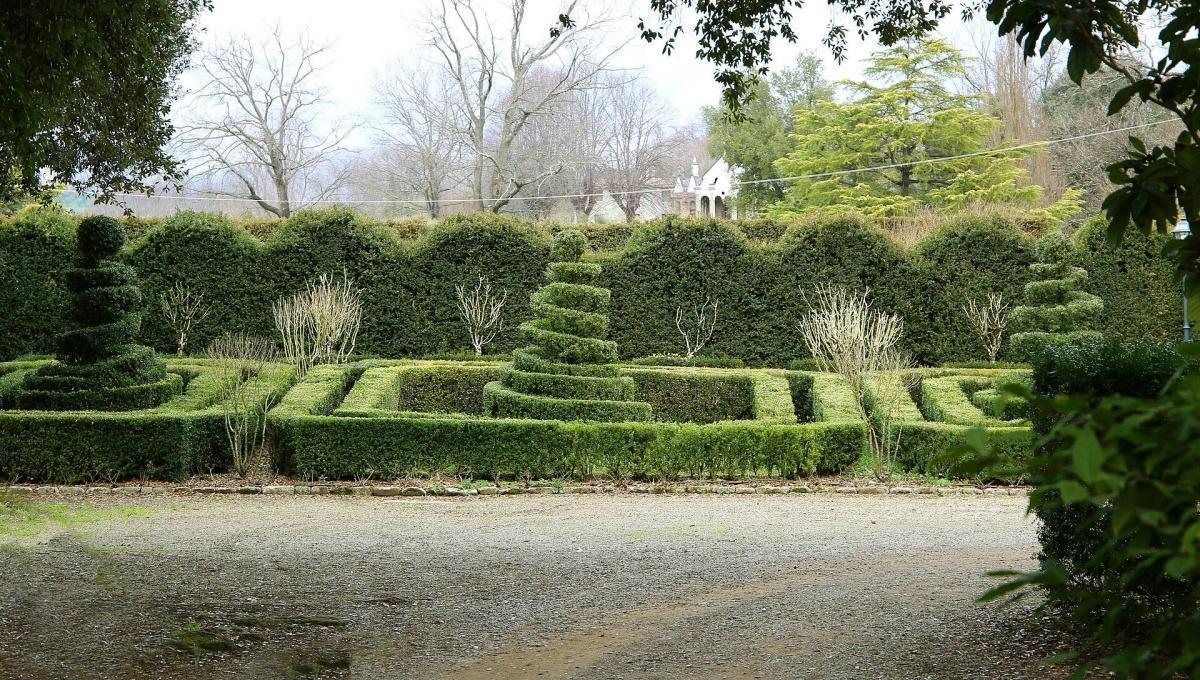
Why Villone Puccini deserves a slow visit
Just north of Pistoia’s historic centre, the park of Villa Puccini di Scornio—known locally as Villone Puccini—offers a very different kind of sightseeing. This is not simply a green space around a country house. It is the surviving landscape of an ambitious nineteenth-century cultural project in which paths, water, monuments and architecture were designed to encourage reflection on art, science, civic responsibility and Italian identity.
For travellers staying at least two days, the park is a rewarding counterpoint to the dense stone streets of the centre. Allow a relaxed half-day rather than treating it as a quick photo stop. Its meaning emerges gradually, in the relationship between formal garden, woodland, lake and symbolic structures.
First, a useful distinction: this is not Giacomo Puccini’s villa
The name often causes confusion. Villone Puccini is associated with Niccolò Puccini (1799–1852), a Pistoian patron, philanthropist and liberal-minded intellectual—not with the opera composer Giacomo Puccini. Niccolò inherited the family estate at Scornio and made it the centre of his cultural and charitable activity.
After travelling through several European countries, he returned with a broad interest in education, the arts and social improvement. The villa became a meeting place for important nineteenth-century writers and political thinkers, while his will directed much of his wealth towards public benefit, including education, books and assistance for people in need.
A Romantic garden built as an open-air book
From 1824, Puccini invested heavily in enlarging and reshaping the estate. By the time of his death, the wider property extended over 123 hectares. Its park followed the Romantic taste of the period: wooded paths, stretches of water, reconstructed medieval and classical forms, picturesque surprises and monuments dedicated to admired figures.
The intention was educational as well as scenic. A walk through the grounds became a sequence of ideas. Art, literature, science and patriotism were translated into viewpoints, sculptures and small buildings. In 1845, Puccini even published a guide to the garden’s monuments with contributions from leading intellectuals of the day.
What to look for as you walk
Do not expect every feature of the original nineteenth-century estate to survive. Instead, look for the remaining fragments of its intellectual programme. Historical research records monuments dedicated to Dante Alighieri, Michelangelo Buonarroti and the naturalist Carl Linnaeus, columns carrying busts of Raphael and Antonio Canova, and a hemicycle honouring Galileo Galilei.
One of the park’s most distinctive architectural ideas was the neoclassical “Pantheon of Illustrious Men”, designed by Alessandro Gherardesca. Water is equally important: lakes and reflections soften the formal symbolism and make the garden feel theatrical. Pause before photographing. The best way to understand the park is to notice how a path reveals—or deliberately hides—each structure.
Philanthropy, agriculture and the Festa delle Spighe
Puccini did not imagine culture as something separated from everyday life. Beginning in 1841, the park hosted the Festa delle Spighe, a three-day gathering that combined religious and public occasions with agricultural competitions, livestock displays and activities involving the schools he supported. The aim included encouraging better farming methods and celebrating education.
This history changes the character of the visit. The park was not created only for private pleasure: it was already open to the public from 1830 and functioned as a stage for learning, debate and social improvement. That civic purpose helps explain why the landscape remains so meaningful to Pistoia today.
How to plan the visit
The public park lies in the Scornio area, roughly north of central Pistoia, and is commonly approached from the Via Dalmazia side. Walking from the historic centre is possible for visitors comfortable with a longer urban stroll; cycling or a short taxi ride may be more convenient. The official Tuscan cycling routes also use the park as a green gateway between the hills and the city.
Opening arrangements, maintenance work and access to individual structures can change. No reliable daily timetable for every part of the complex was published when this guide was checked, so confirm locally before making the park the focus of a tightly scheduled day. The historic villa and privately managed event areas should not be assumed to be freely accessible: remain on public paths and respect gates, signs and staff instructions.
Families, mobility and practical comfort
The combination of open space, water and architectural surprises can work well for families, especially after a museum-heavy morning. Keep children close to the lakes and around uneven historic features, and do not feed wildlife unless current park rules explicitly permit it. Bring water and insect protection in warm months; after rain, shaded paths may be muddy or slippery.
Visitors with limited mobility should expect a historic landscape rather than a fully level formal garden. Surfaces, gradients and the condition of paths can vary. If step-free access is essential, ask the Pistoia tourist office or municipality for current information before travelling. A compact route around the most accessible public areas may be more enjoyable than trying to cover every path.
The best seasons and the right pace
Spring brings fresh growth and comfortable walking temperatures, while early autumn gives the park softer light and a quieter atmosphere. Summer visits are best in the cooler morning or late afternoon, with protection from heat and mosquitoes. Winter reveals the bones of the design—views, masonry and formal geometry—but rain can affect paths.
Allow at least ninety minutes, and more if you enjoy garden history or photography. This is a place for looking slowly rather than collecting landmarks. Read a little about Niccolò Puccini before arriving, then let the sequence of water, trees and monuments do the rest.
A two-day Pistoia itinerary built around the park
Day one: explore the historic centre, beginning in Piazza del Duomo and continuing to the Cathedral, Baptistery and one of Pistoia’s Romanesque churches. Add the Civic Museum or Palazzo Fabroni, then spend the evening around Piazza della Sala. This gives you the city’s monumental and social core.
Day two: visit Villone Puccini in the morning, when the park is usually calmer and the light suits the water and trees. Afterwards, return towards the centre and connect Niccolò Puccini’s legacy with the Biblioteca Forteguerriana or the Civic Museum’s Puccini collection, subject to current opening arrangements. The pairing turns a pleasant garden walk into a coherent story about patronage, education and public culture.
Sources
- Visit Tuscany — By bike from the Apennines to Pistoia
- Visit Tuscany — Cycling through the Pistoia hills
- Finestre sull’Arte — Niccolò Puccini, patron and philanthropist
- Visit Tuscany — Villas and gardens for a memorable walk
- Wikimedia Commons — cover photograph by Sailko, CC BY-SA 4.0

Information checked on 23 September 2026. Access conditions and the state of individual paths or structures may change; verify locally before visiting.